A ways-to-win slot evaluates matching symbols across adjacent reels without requiring a payline. Multiple copies can create several combinations from one result. The advertised ways count describes position paths, not the chance of profit.
The mechanic looks simple because no line map is needed, yet the result still depends on direction, consecutive reels, symbol counts, wild rules and the paytable. Those details decide which combinations qualify and how the total award is calculated.
A way is a combination of reel positions
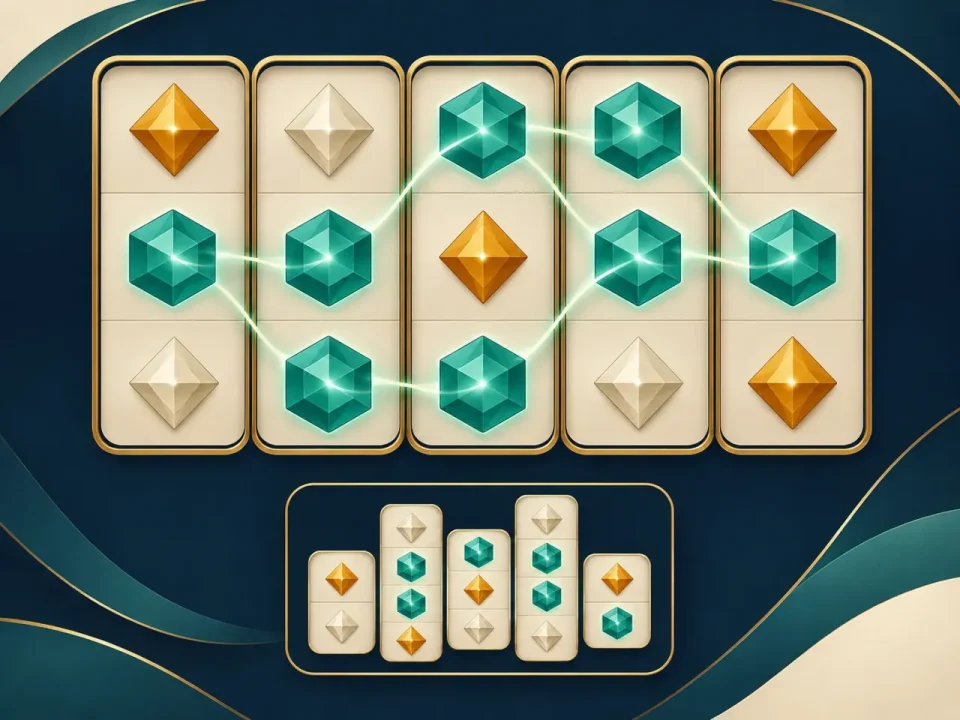
A fixed-payline game asks whether symbols occupy one of the routes drawn in advance. A ways game usually asks whether a qualifying symbol appears on the required number of adjacent reels, often beginning with the leftmost reel. Its vertical row does not need to stay the same from reel to reel. A symbol near the top of one reel can combine with a copy near the bottom of the next if the rules only require reel adjacency.
The Play'n GO description of 7 Sins gives a direct example. It describes three rows and five reels with no fixed paylines, uses a win-any-way principle and states 243 ways to win. The named product also has its own wild, scatter and feature rules, so its page is evidence for the layout rather than a universal paytable.
The GLI-11 gaming-device standard requires game information to explain the order in which symbols must appear. It also says the rules should disclose whether wins are evaluated left to right, right to left or in both directions and whether symbols must appear on adjacent reels or are paid as scatters. That disclosure is essential because the phrase ways to win does not settle every one of those questions by itself.
Why a five-by-three grid can show 243 ways
A five-reel grid with three visible positions on each reel has three choices of position per reel. If a five-symbol award may use any one position on each of the five consecutive reels, the number of possible position paths is three multiplied by itself five times. The result is 243.
That headline number does not mean 243 symbol types, 243 simultaneous prizes or a 243-in-something chance of winning. It counts geometric position combinations available to a five-reel match under the stated evaluation rule. Whether any path actually contains matching eligible symbols depends on the generated reel result and the paytable.
The official Caishen's Gold page identifies another three-by-five video slot with 243 ways. The common number follows from the grid shape, but the symbol strips, features, RTP and award values can still differ completely from another 243-way title.
Count copies on each qualifying reel
Consider one ordinary symbol that appears twice on reel one, three times on reel two and once on reel three. If the rules pay that symbol for three adjacent reels from the left, each position on the first reel can combine with every eligible position on the second and third. Multiplying two by three by one gives six three-reel ways.
If two copies of the same symbol also appear on reel four, the four-reel count becomes two multiplied by three multiplied by one multiplied by two, or twelve. A gap usually stops an adjacent-reel match. If reel three contains no copy and no valid substitute, copies on reels four and five normally cannot bridge that missing reel.
The paytable decides whether the twelve four-reel combinations receive the four-symbol value, whether a shorter overlapping result is also paid and whether only the longest award per position path is used. GLI-11 requires coinciding outcomes and the rule for paying only the highest combination to be explained. It is therefore unsafe to add every shorter count unless the particular help screen says they are cumulative.
Ways are not drawn paylines
The Atlas explanation of fixed and adjustable paylines describes routes that must be active before a spin. A ways game removes the need to fund or trace individual zigzags when every eligible position combination is evaluated under one common rule. The winning display may still draw connecting highlights after the result, but those highlights explain combinations rather than a preselected line set.
Direction remains separate from geometry. A game can evaluate only from the leftmost reel, pay from either edge or apply different starting rules to particular symbols. A phrase such as all ways does not automatically mean both directions. The help screen should identify the starting reel and the minimum number of consecutive reels required for each award.
Cluster pays are another mechanic. They usually reward a group of touching symbols anywhere in an eligible grid rather than a sequence across consecutive reels. Scatter pays can ignore adjacency and direction. A title can combine ways, clusters, scatters and features, so the label on the main mechanic does not describe every possible prize.
Wilds change the eligible symbol count
A wild can stand in for ordinary symbols only where the rules permit. If one natural symbol and two valid wilds appear on a required reel, all three positions may contribute to the way count for that symbol. A wild can have restrictions, appear only on specified reels, carry a multiplier or use a separate paytable. Those conditions must be applied before multiplying positions.
Scatter symbols generally follow their own rule. They may pay for a count anywhere on the grid or trigger a feature without starting on the first reel. Their positions should not be inserted into an adjacent-reel ways calculation unless the game explicitly defines them as substitutes or eligible ways symbols.
Coinciding wild awards also need care. A displayed result might qualify as a high-paying symbol through substitution and as a wild combination in its own right. The rules can pay the higher result, both results or another stated treatment. Visual highlighting is useful, but the paytable and game history remain authoritative.
Dynamic ways change with reel height
Some games vary the number of visible positions from spin to spin. Big Time Gaming's description of the Megaways mechanic calls it a random reel modifier that can show a variable quantity of visible symbols on the reels. In such a design, the maximum ways figure and the active ways on one result are not necessarily the same.
Multiplying the visible eligible positions across six reels gives 117,649 when all six show seven positions, because seven is multiplied six times. The official Mustang Gold Megaways page identifies a six-by-seven layout and 117,649 ways. Actual evaluation still follows that game's rules, including tumbles, special symbols and feature states.
Expanding reels, split symbols or an extra reel can produce different advertised totals. The count should be reconstructed from the exact layout and rule, not inferred from the trademark or a similar title. If reel heights change, a current-ways display is informative only for that round and does not predict the symbol result.
More ways do not state the RTP
A larger ways count covers more position paths, but it does not reveal symbol probabilities, paytable values or the price of a round. A 243-way game can have a higher, equal or lower RTP than a game advertising many more ways. The mathematical design can balance additional combinations with rarer symbols, smaller awards or other changes.
The return-and-variance guide explains why return and hit frequency are separate from a mechanic label. More frequent qualifying combinations can still include many returns below the total stake. Volatility depends on how award sizes and probabilities are distributed, not on the ways count alone.
The GLI explanation of game testing says mathematical simulation and forced outcomes are used to verify multi-ways wins and confirm that awards match the advertised rules. That work checks a complete game model. It does not turn the number printed beside ways into a standalone probability of winning.
Read the stake as one total commitment
Many fixed-ways games present one total-bet control rather than a price per way. The 243 paths are then evaluation possibilities inside the funded round, not 243 separately purchased tickets. Other interfaces can offer stake levels, optional features or changing configurations, so the amount debited must be checked rather than inferred from the headline count.
The round-cost guide explains how denomination, bet level and optional purchases combine. If a feature increases the reel height or activates more ways, confirm whether that state is included in the base wager, awarded through play or purchased separately. A higher maximum ways figure is not free evidence of better value.
The outcome-source guide also separates symbol generation from evaluation. The RNG or other certified outcome process determines the reel stops or symbols. The ways rule then examines the displayed positions. Changing the visible path count after a result would not be a legitimate way to alter a chosen outcome.
The final check is the paytable
Before a round, identify the starting reel, direction, adjacency requirement, minimum match length and whether reel heights can change. Read how natural symbols, wilds and scatters are treated. Confirm whether coinciding awards are cumulative, whether tumbles create new evaluations and what the total wager covers.
After settlement, the highlighted symbols should agree with the paytable and history. Recount each winning symbol by multiplying its eligible copies on consecutive reels, then apply the stated award and multiplier rules. If the figures disagree, preserve the version, round identifier and wager instead of testing the issue with another bet.
Ways-to-win mechanics make many position combinations eligible without fixed line maps. They do not make every symbol arrangement a win, guarantee a particular hit rate or improve the long-run return by themselves. The useful number is the one that can be reconciled with the current grid, rules, stake and recorded result.