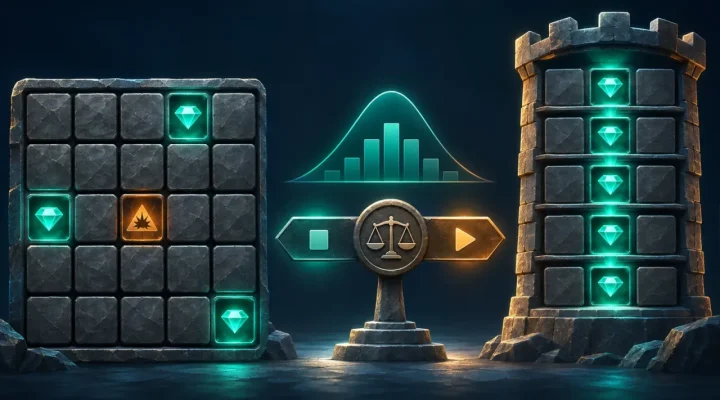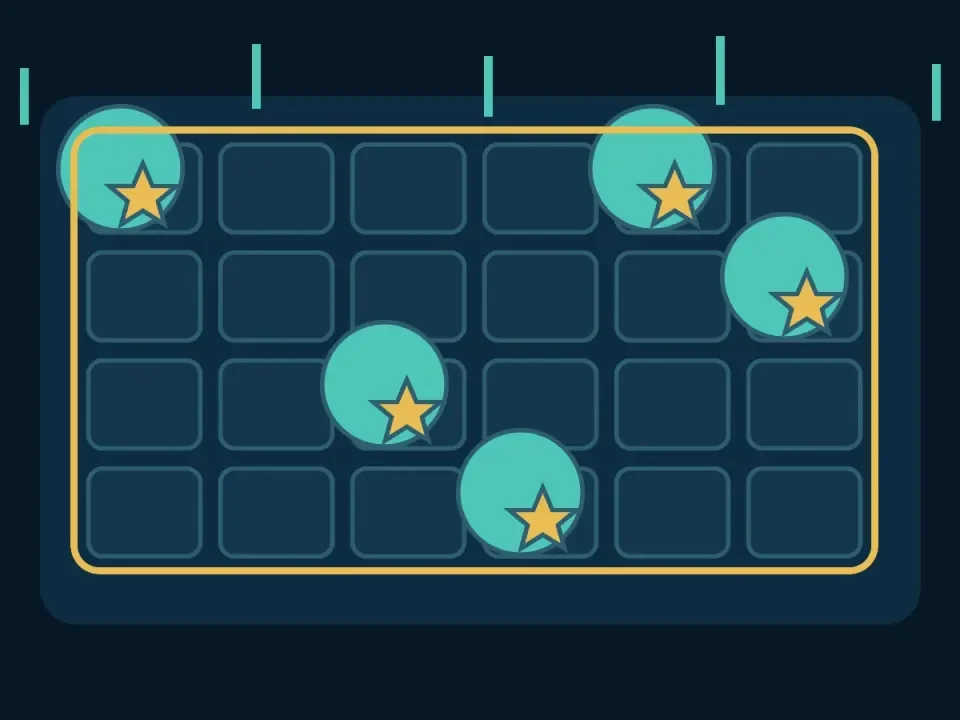
Pay Anywhere changes how a slot identifies a matching-symbol win. Instead of tracing a fixed payline or requiring symbols to appear on consecutive reels, the game counts qualifying copies across the evaluated grid. Their positions can be separated. What matters is the symbol count and the paytable for that particular game.
The label is also used as Scatter Pays in some products, but that does not mean every symbol becomes a conventional scatter. Ordinary paying symbols can use the anywhere rule while bonus scatters, wilds, multipliers and collection symbols keep separate instructions. The current help screen is therefore more important than the broad feature name.
Position stops mattering but the threshold still matters
The official Wisdom of Athena 1000 page describes a six-by-six pay-anywhere grid where four or more matching ordinary symbols award a win. Those matching symbols do not have to touch or begin on the left. A symbol in one corner can be counted with copies elsewhere on the board if all of them are inside the evaluated area.
Four is not a universal number. Push Gaming's Goat Getter description requires six or more matching symbols anywhere on its five-by-six board. Play'n GO's Rise of Olympus 1000 rules use eight or more matching symbols. A player cannot carry the threshold from one title into another.
The evaluated area can also change. Wisdom of Athena 1000 begins with positions on its top row locked and can unlock them during cascades. Symbols outside the open area do not exist for the current evaluation. A grid advertised as six by six therefore needs to be read together with any locked positions, expanding rows or feature-specific layouts.
Pay Anywhere is not the same as Cluster Pays
Both mechanics often appear on large grids, but they ask different questions. Pay Anywhere asks how many qualifying copies of a symbol are visible. Cluster Pays asks whether enough matching symbols form a connected group. The FairDealer guide to Cluster Pays explains that cluster members normally touch horizontally or vertically. Two separate groups may be evaluated independently even if they show the same symbol.
A pay-anywhere result can look like several disconnected islands and still qualify because the game totals every relevant copy. A cluster result can fail even with many copies on screen when they are split into groups below the required size. Some marketing pages use the words cluster and scatter loosely, so the decisive information is the game's own definition of a winning combination.
Ways-to-win systems are different again. They normally require matching symbols on consecutive reels beginning from a specified side, although the row position can vary. FairDealer's guide to ways to win shows why a large ways count does not mean every matching symbol anywhere on the screen is automatically combined.
Cascades are the next step, not the win rule itself
Many pay-anywhere games remove winning symbols and let replacements fall into the empty positions. This is a cascade, tumble or drop. It happens after the game has already used the pay-anywhere rule to identify a win. A new evaluation then occurs on the changed grid.
The three official examples reviewed here all pair their symbol count with a cascade. That pairing is common because a large board can produce a sequence of changing counts from one paid spin. It is still useful to keep the rules separate. Pay Anywhere determines which symbols form a win. The cascade determines what happens to the board afterwards.
A cascade can end immediately when the replacement grid does not contain enough matching symbols. It can also continue through several evaluations. Whether multipliers persist, increase, reset or apply only to one tumble depends on the title. A sequence of cascades belongs to one initiated round only when the rules say so, and it should not be mistaken for several independent paid spins.
The paytable converts a count into a value
Once a game counts a qualifying symbol, the paytable assigns a value to the total number collected. A title may publish bands such as four, five, six or more copies, with a different award for each band. Another may begin at eight and use wider bands. The value can be expressed as credits or as a multiple of the total stake.
Wilds may substitute for ordinary symbols, but some games restrict where they appear or which symbols they replace. Scatters may pay anywhere under their own table while also triggering a feature. Coin or cash symbols can use an independent count-and-collect rule. These symbols should not be merged into the ordinary pay-anywhere total unless the rules explicitly do so.
The UK Gambling Commission's RTS 3 requires applicable rules and useful likelihood information to be available before gambling. For this mechanic, the practical reading includes the minimum count, count bands, open grid positions, wild and scatter treatment, cascade behavior, multiplier timing, stake basis, maximum win and RTP for the exact version.
A crowded screen is not a forecast
Pay Anywhere makes every position visually relevant, which can make near misses feel unusually prominent. Three matching symbols scattered around a game that requires four may look close, but they do not carry value unless the paytable awards that count. Their locations do not make the missing copy more likely on the next spin.
The same caution applies during cascades. A board that already contains several copies can have a higher visible starting count for the next evaluation, but the new symbols are still produced by the game's outcome system. The UK Gambling Commission's RTS 7 says random outcomes should follow their theoretical probabilities and be unpredictable. Previous boards do not reveal a pattern that can force the next one.
A larger grid or lower threshold can make qualifying combinations appear more often, yet frequency alone does not establish a better return. Symbol probabilities, awards, wild behavior, cascade rules and maximum limits all contribute to the mathematical model. RTP remains a long-run measure and cannot promise the result of a spin or session.
Before staking, open the help screen and identify the exact winning rule in plain language. Confirm whether all matching symbols are counted, which positions are active, how many copies are required and what happens after a win. Pay Anywhere removes positional paths from the combination, but it does not remove the threshold, the paytable or chance.