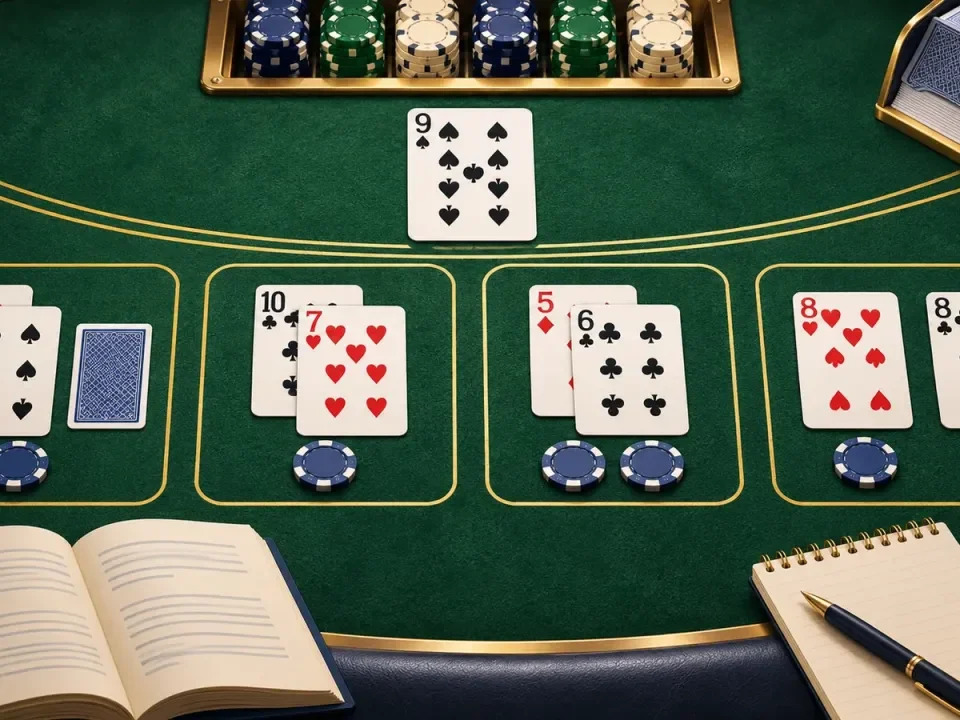
Blackjack gives the player several choices after the cards are dealt, but those choices operate inside a game that still contains chance and a house advantage. The aim is to finish with a hand that beats the dealer without exceeding 21. Reaching 21 is useful, but a lower total also wins when the dealer busts or finishes with less.
The cards create the situation and the player chooses how to continue. A decision can change the mathematical expectation of that hand, yet it cannot control the next card. The MGM GameSense guide makes both points directly. It defines the common actions and warns that a statistically correct play does not guarantee a winning result.
Read the hand before choosing
A player hand is normally read as hard, soft or paired. A hard total has no ace currently counted as 11, either because there is no ace or because counting one that way would cause a bust. A soft total includes an ace valued as 11 and can absorb one high card by changing that ace to 1. A pair can open the option to split when the table rules permit it.
The dealer's exposed card is the second part of the decision. It is not a prediction of the hidden card. It tells the player which fixed dealer process the hand will face after player decisions end. Blackjack is therefore a house-banked game, even when several people sit at the same table. FairDealer's guide to P2P and house-banked games explains why every player settles against the dealer rather than against the other seats.
Hit and stand change exposure
Hit means taking another card. The new value may improve the hand, leave it unchanged when a soft ace changes value, or push it over 21. A bust ends that hand before the dealer completes its own draw. Stand ends the player's drawing and keeps the current total for comparison with the dealer.
These actions are not labels for brave or cautious play. They are responses to the composition of the hand, the dealer upcard and the applicable rules. Standing avoids the risk of drawing another card but accepts the present total. Hitting accepts additional bust risk in exchange for the possibility of improving a total that may otherwise lose to the dealer's completed hand.
The dealer does not choose freely. The house rules require the dealer to draw and stand at stated totals. One especially important distinction is whether the dealer hits or stands on soft 17. The answer changes some player decisions, so a chart made for one soft-17 rule should not be transferred silently to another.
Double and split change the stake
Double down adds an amount equal to the original main wager and normally gives the player exactly one more card before an automatic stand. Some games allow doubling on any first two cards, while others restrict it to stated totals or restrict doubling after a split. The decision therefore combines card exposure with a larger amount at risk. If the interface does not disclose when doubling is available, its own current rules are the authority.
Split turns a qualifying pair into two hands and requires another wager for the new hand. Each hand is then played and settled separately. Restrictions can apply to which ranks may be split, how many times a pair may be split again, whether split aces receive only one card and whether doubling is allowed after the split. A two-card 21 formed after a split is also commonly treated differently from an original blackjack.
The Spanish basic blackjack regulation illustrates why details matter. It sets a general framework but leaves operators to publish particular rules, and it distinguishes Classic, American, Surrender, Pontoon and Super 21 forms with different dealing, doubling, surrender and settlement mechanics.
Surrender and insurance answer different questions
Surrender ends the original hand early and normally returns half of its stake while the other half goes to the house. It is not available at every table, and timing matters. A late-surrender rule may allow the choice only after the dealer has checked for blackjack, while another game may not offer surrender at all. A strategy instruction to surrender is meaningless unless the exact option exists under the current rules.
Insurance is a separate side wager offered when the dealer shows an ace under common rules. It is settled on whether the dealer's hidden card completes blackjack, not on whether the player's main hand eventually wins. Taking insurance does not make the original wager safe. It adds another wager with its own payout and probability. Side wagers such as pair or three-card combinations should be read the same way because their paytables are separate from the main hand.
One basic-strategy chart is not universal
A basic-strategy chart maps a defined player state to an action against each dealer upcard. A row may represent a hard total, soft total or pair. The matching column represents the dealer's visible card. Some charts also show a fallback action when double or surrender is not permitted. The chart is a compact result of a specified rule model, not a prediction of the next card.
Before using one, identify the deck count, the dealer's soft-17 rule, the blackjack payout, the doubling restrictions, the split and resplit rules, treatment of split aces and surrender availability. MGM notes that blackjack payouts may be 3 to 2 or 6 to 5 and that the applicable odds are displayed at the table. A chart can reduce avoidable decision errors only when its assumptions match those displayed rules.
Current products make the variation visible. Evolution's blackjack catalogue describes classic, infinite and modified games with different seat structures, side wagers, special draw rules and altered doubling options. A familiar blackjack label therefore does not prove that a familiar chart applies unchanged.
Check the rules and the cost together
The UK Gambling Commission's RTS 3 says remote games should make their rules, deck or shuffle information where relevant, payout information and a likelihood measure available before a customer commits to gamble. It also says an RTP for a game with a skill element should be calculated using an auto-play strategy or a standard published strategy. That assumption matters because a displayed percentage may describe modeled play rather than every set of decisions.
House edge and RTP are long-run measures. The Commission's player explanation of RTP and house edge says casino games including blackjack give the house an average advantage under normal patterns of play. FairDealer's guide to RTP and house edge explains why that average is not a fixed deduction from each hand and cannot forecast a short session.
A careful player can verify the table rules, use a matching reference chart and understand how each action changes the current hand. None of those steps removes random card order or turns blackjack into income. Decide a spending limit and a time limit before play, include added stakes from doubles, splits, insurance and other side wagers in the total cost, and stop when either limit is reached.