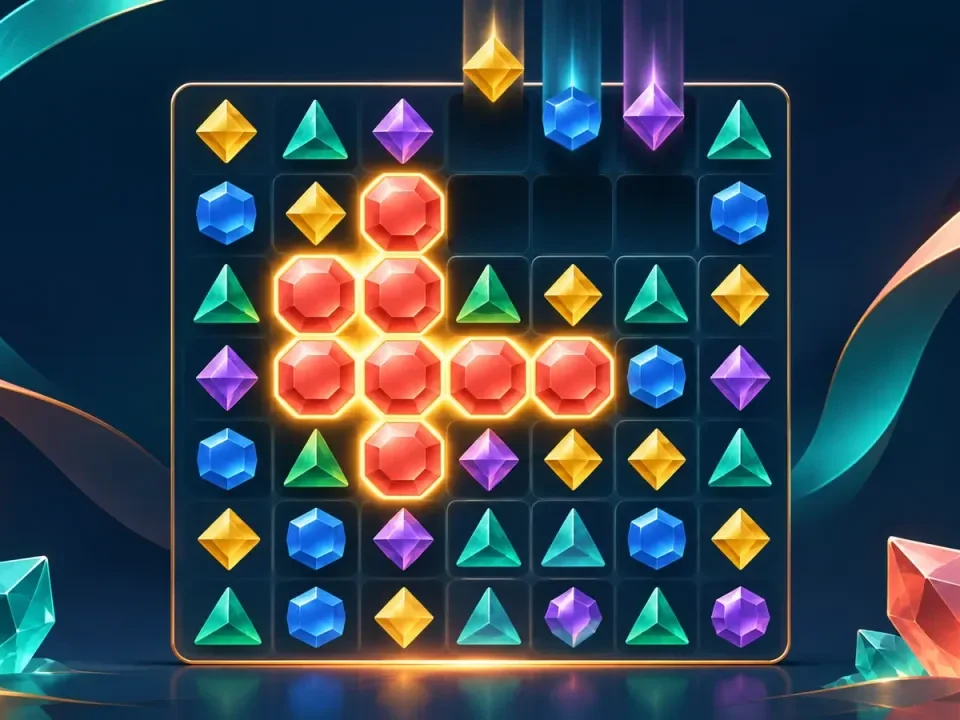
Cluster Pays changes the shape of a slot win. Instead of tracing matching symbols along a fixed line, the game looks for a connected group on its grid. That sounds simple, but the label does not define one universal rulebook. The number of symbols required, the way they must touch and what happens after a win all depend on the title being played.
How a cluster becomes a win
A cluster begins when matching symbols occupy neighbouring positions. In the rules for The Legend of Shangri-La, a symbol joins a cluster only when it touches the same symbol horizontally or vertically. Diagonal contact does not count in that game. The same rules require at least nine connected symbols before the paytable awards a win. The published game help also says that simultaneous clusters are added and that two disconnected groups of the same symbol are evaluated separately.
That threshold is not portable. Pragmatic Play's official Cosmic Clusters page describes wins from groups of five to fourteen matching symbols on a six-by-six grid. Other games can use a different grid, a different minimum or special treatment for oversized symbols. The correct test is always the current paytable and help screen for the exact version available to you.
A useful way to read the board is to begin with one symbol and follow only permitted edges. If the rules say horizontal and vertical contact, a matching symbol one square above, below, left or right belongs to the same connected component. A matching symbol that touches only at a corner remains outside it. When the connected component reaches the stated minimum, its size and symbol type are matched to the paytable.
Cluster Pays is not the same as Ways to Win
Both systems remove the need to follow a small set of drawn paylines, but they count wins differently. Ways to Win usually asks for matching symbols on consecutive reels and multiplies the number of qualifying positions. Cluster Pays cares about connected positions on a grid, so the shape can bend upward, downward or sideways. FairDealer's guide to Ways to Win in slot games explains that reel-based model, while the guide to fixed and adjustable paylines covers the more traditional line structure.
The visual layout alone is not enough to identify the system. A square grid may still apply a proprietary ways mechanic, and a reel-shaped game can count adjacent clusters. The game's own pay type and paytable settle the question.
What happens after a winning group
A cascade, tumble or avalanche is a separate post-win feature. Cosmic Clusters removes winning symbols and lets replacements fall into the grid, which can create another evaluated layout. Its money symbols, random Wild and bonus behaviour add further title-specific rules. By contrast, NetEnt's Aloha! Cluster Pays page describes Sticky Win Re-spins as one feature and a Symbol Drop mechanic inside Free Spins as another. Cluster recognition and symbol replacement therefore should not be treated as synonyms.
The distinction matters when reading a win sequence. The first cluster is evaluated under the paytable. Only then does the game apply any removal, refill, multiplier or re-spin rule that its help file specifies. A later cluster can be part of the same paid sequence, but it is not evidence that another win was due. Each outcome remains governed by the game's certified random process.
Wilds, scatters and overlapping groups
Special symbols do not have a universal Cluster Pays behaviour. A Wild may substitute for ordinary symbols, carry a multiplier or remain fixed, but it may also be barred from replacing a Scatter or bonus symbol. The Aloha rules, for example, say its Substitution Symbol chooses an adjacent symbol that creates the highest available cluster and cannot replace Free Spin symbols. Cosmic Clusters gives money symbols their own cluster calculation and uses Scatters to trigger its bonus.
Overlapping shapes require the same caution. Some games combine all connected symbols of one type into one cluster. Others may have oversized or transformed symbols that count in a special way. Do not add the same symbol twice or assume two visual shapes pay separately unless the rules explicitly say so.
How the stake and paytable interact
The paytable normally maps symbol type and cluster size to a value, then applies the selected stake according to that game's formula. The Legend of Shangri-La rules express the cluster award in coins, multiply it by the bet level and then convert it using the coin value. A different title can display direct stake multipliers instead. This presentation changes how the calculation is shown, not whether the next spin can be predicted.
RTP, volatility and hit frequency remain properties of a specific configuration. Cluster Pays describes how a result qualifies, not how often it must occur or what a session will return. A larger-looking grid does not by itself create a higher RTP, and a recent sequence of non-winning spins does not make a cluster more likely on the next one.
A careful way to check any cluster game
Open the current game information before placing a stake and confirm the minimum cluster size, permitted directions, treatment of separate groups and the role of every special symbol. Then distinguish the base cluster calculation from cascades, re-spins, multipliers and bonuses. Check the RTP and stake range for the version supplied by your operator, because providers can certify more than one configuration.
Cluster Pays can make wins easier to visualise because connected shapes are highlighted directly on the grid. It does not provide a strategy that forces those shapes to appear. Choose a spending and time limit before play, treat demo mode as a way to learn the interface rather than predict results, and stop when the planned limit is reached.