An instant-multiplier game resolves one wager inside a private round. A single-player crash game may animate that result as a journey, but no shared cash-out race is required.
The words instant and crash describe presentation families rather than one universal rule. The useful questions concern when the result is fixed, what changes the displayed balance and whether the player has any decision after the round starts.
A private round can use a crash-style journey
Classic shared crash games show many participants the same rising multiplier. Each person tries to cash out before the common endpoint. A single-player version instead starts a separate result for one accepted wager. Its animation can rise, fall or end in a crash, but another player's timing does not define the settlement.
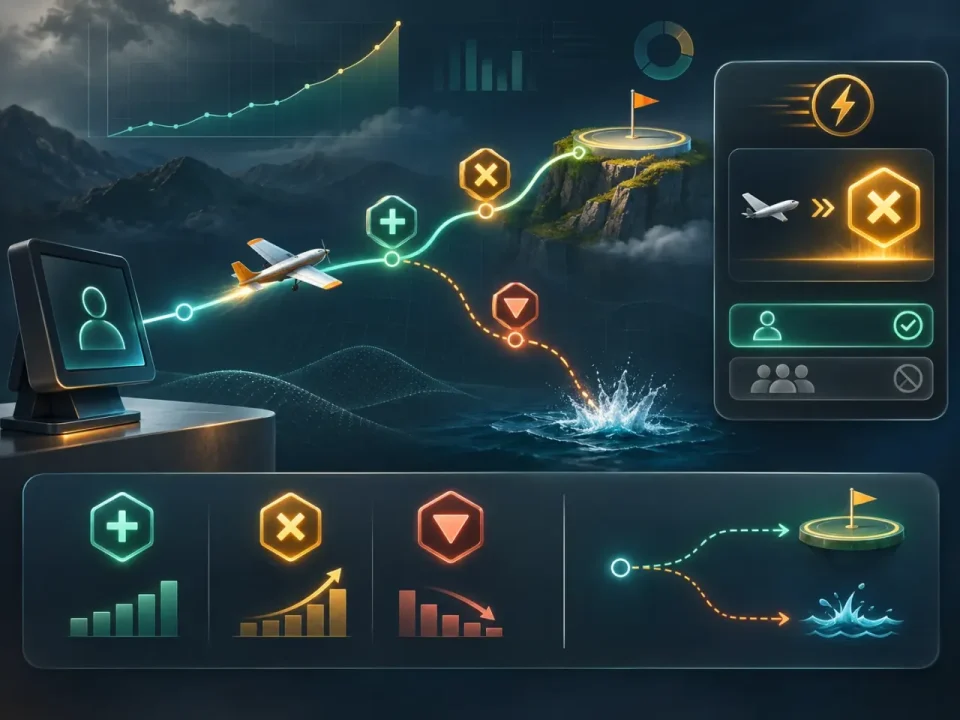
The official Aviamasters rules from BGaming provide a current example. The round begins at 1.0x. A number can be added to the current multiplier, a multiplier symbol can multiply it, and a rocket can divide it by two. If the aircraft lands on the ship, the final value applies to the wager. If it falls into the water, the wager loses.
That sequence is not a manual cash-out race. The rules describe choosing a stake and pressing Spin, after which the flight resolves. The player watches intermediate state changes but does not decide when to bank them during the ordinary round. A landing condition, rather than a button press before a shared crash point, determines whether the accumulated value is payable.
This difference separates the topic from the shared-round crash guide. Shared and private games may both use aircraft, curves or the word crash. Their images do not establish the acceptance boundary or settlement rule. Only the help screen and wager record for the named title do that.
An instant multiplier can be revealed with or without a journey
Some games generate one multiplier and reveal it immediately after the wager is accepted. Others disclose the same kind of final value through several visual steps. The length of the animation does not prove that the underlying random process is still changing while the player watches.
The important distinction is between result generation and presentation. A certified RNG can select the complete round outcome before the animation finishes. The client then displays the selected path, while the server records the authoritative result. A stop, turbo or speed control may shorten the reveal without rerolling the outcome.
BGaming's current Aviamasters product page says players set a wager and pace, then watch a random flight path encounter additive values, multiplying values and rockets. Its rules also offer four visual flight speeds. The selected speed changes how quickly the path is shown, not the mathematical value assigned to an already accepted round.
Under the UK Gambling Commission's random-result requirements, an RNG must produce output that can be shown to be random and that players cannot feasibly predict. The same requirements reject adaptive probability changes and bind settlement to the rules and payments in force. The RNG and outcome-source guide explains why the screen that reveals a result is not necessarily the component that generated it.
Intermediate values may not be available to collect
A path can show a temporary balance rising after a multiplier and falling after a penalty. That display is part of the round state, but it is not automatically withdrawable. In the Aviamasters example, all obtained multipliers apply only when the plane lands on the ship. A water ending loses the wager, even if the screen showed a higher temporary value moments earlier.
A player should therefore look for an explicit Collect, Cash Out or Stop rule. If no such action is documented, the moving value should not be treated as money already credited to the account. The authoritative evidence is the final settlement in game history, not the highest point reached by the animation.
Addition and multiplication also produce different effects. Starting from 1.0x, adding 2 produces 3.0x, while multiplying by 2 produces 2.0x. A later division can reduce either path. The official rules define the order in which encountered symbols change the current value, so multiplying all visible symbols together would be the wrong calculation.
Rounding can matter as well. The named rules say that profit above the wager is rounded up to the nearest whole number and a result below the wager is rounded down. That is a product-specific instruction, not a genre standard. Another title may use currency precision or a different rounding rule.
Maximum multiplier and RTP answer different questions
A maximum multiplier is the largest permitted settlement under the game's configuration. It does not state how often that result occurs and it is not the RTP. Expected return depends on every possible path, the chance of a successful ending, penalties, caps and the value assigned to each payable outcome.
The BGaming product page currently presents Aviamasters with a maximum of 250x and describes low volatility. Those facts belong to the named product. Operators can also expose different permitted features or configurations where licensing rules allow. A player should read the information inside the offered game rather than relying on an advertisement or on figures from a similarly themed title.
The UKGC rules and likelihood standard says the mechanics, winning conditions and an appropriate likelihood measure must be accessible before wagering. The RTP and volatility guide explains why a long-run average cannot predict the result of one private round.
Neither a sequence of water endings nor several successful landings changes the next certified draw unless the rules expressly describe a persistent feature. A history panel records completed rounds. It does not make a multiplier, rocket or safe ending due.
Autoplay repeats wagers and does not improve them
The official rules offer an autoplay mode with a chosen number of rounds and stop conditions. Autoplay places repeated wagers under the same game model. A stop after a win, balance increase or balance decrease controls when repetition ends; it does not alter the probability distribution of the next round.
The UKGC autoplay standard requires customers to commit to each game cycle individually for applicable remote gaming and restricts automated play in its current regulated context. The BGaming rules accordingly note that autoplay or quick spins can be unavailable because of the operator's licence. Feature availability should never be assumed from a provider demonstration.
Repetition also changes spending speed. A one-unit stake repeated fifty times creates fifty units of turnover before returns, even when each animation lasts only seconds. The full round-cost guide explains why stake, pace and number of rounds must be considered together.
Pauses and disconnections need the recorded result
Opening rules, changing visual speed or losing a connection may interrupt what the device shows. They do not necessarily cancel an accepted wager. The official Aviamasters rules say opening the rules during a round pauses the game and describe how unfinished rounds are resolved after a long interruption.
The UKGC interrupted-gambling standard requires fair policies and enough retained information to restore or resolve interrupted events. The GLI-19 interactive gaming standard likewise addresses wager records, game history and the treatment of interrupted games.
After a freeze, reopen history and compare the round identifier, accepted stake, final multiplier, ending condition and balance entry. Do not infer the result from the last visible frame or place another wager to test whether the first one settled.
Read the settlement boundary before playing
Before staking, identify whether the round is shared or private, whether the multiplier is an immediate reveal or an animated path, and whether any mid-round player action can lock in a value. Confirm how additions, multiplications and penalties are applied, which ending is payable, how rounding works and what maximum win or cap applies.
A single-player crash presentation can feel interactive even when the only financial decision is the initial wager. An instant reveal can feel simpler even though it uses the same kind of random result selection. Neither format creates a reliable timing strategy, and no display pattern or speed setting guarantees a profit.