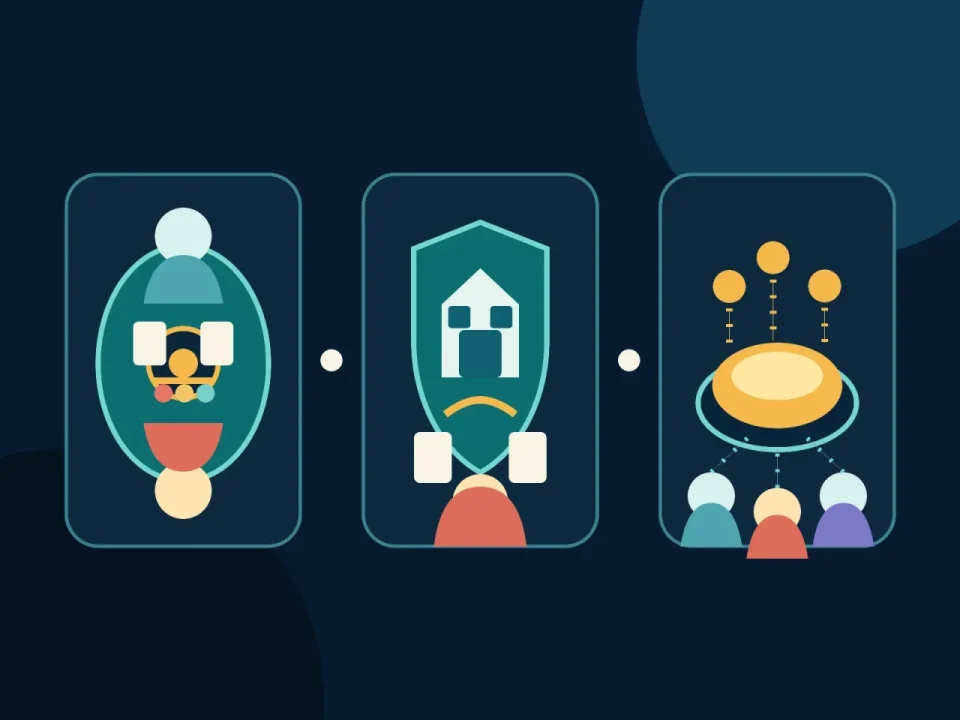
A poker table, a dealer game and a jackpot title may all show cards, chips and several players. The pictures do not tell you who is taking the other side of the wager or where a payout comes from. Those questions separate peer-to-peer play, house-banked play and a shared prize pool. They also reveal why the three labels are not interchangeable.
This guide extends FairDealer’s map of gambling families and mechanics. The earlier map separates a game’s family from its settlement model. Here the focus is the settlement model itself and the trail followed by the money.
P2P describes the opponents
In peer-to-peer play, customers compete with other customers rather than with the operator’s bankroll. The UK Gambling Commission’s technical definitions use poker and betting exchanges as examples. The operator can still run the software, seat the players, safeguard balances and enforce the rules. What makes the game P2P is that the participants take opposing positions.
Conventional cash poker shows the distinction clearly. Players contribute wagers to a pot, and the qualifying winning hand takes that pot under the table rules. The operator normally earns a rake or fee instead of playing a hand with its own money. In tournament poker, entry money assigned to the prize fund can be separated from the charge for using the room. The exact deduction method matters because a percentage rake, a capped rake and a fixed tournament fee affect the money flow differently.
P2P does not mean cost-free or operator-free. It also does not mean every participant has the same chance. Decisions by other players, table position, skill, stack sizes and the game rules can influence outcomes. That is why the Commission’s disclosure standard says that a P2P game should explain how it works, how winners are determined and what rake or commission is taken. A single house-edge figure may not describe this relationship.
House-banked describes the counterparty
A house-banked game places the operator, represented by the game or dealer, on the other side of each player’s wager. Blackjack and many casino poker variants follow this structure. Other people may sit at the same table, but one player’s result is settled against the house rules rather than paid from another player’s stack. A title can therefore use poker hands without being P2P.
The paytable or settlement rules state what the house pays for a winning outcome and what it collects for a losing one. Depending on the product, useful risk information may be expressed through probabilities, return to player or house edge. These are long-run mathematical descriptions, not a promise about one round or session. A live dealer, a social chat and a crowded table do not change the counterparty.
Table interaction can still matter operationally. Seats may share community cards, a shoe or the timing of a round. That shared presentation does not create a common prize fund unless the rules actually combine contributions and allocate them from a pool. The financial test remains more reliable than the screen layout.
A shared pool describes the source of prizes
A pooled product combines stakes or designated contributions and pays winners from that accumulated amount after stated deductions. The final value can depend on how much entered the pool, how much the operator deducts and how many winning units share the distributable balance. A player may therefore know the winning condition before betting without knowing the eventual payout.
Pool betting is one example. Participants make selections on the same event, part of the combined stakes is allocated to winners, and the operator removes the disclosed commission. This resembles P2P because players’ money supplies the prize, but the pool is still a funding and allocation mechanism. It does not necessarily involve players making tactical decisions against one another during a game.
A poker pot is also shared money, yet it belongs to one hand or tournament under poker rules. A lottery prize tier may collect money across a much larger field and divide it among all qualifying entries. The phrase shared pool therefore needs a second question about scope. Players should know which stakes feed it, which deductions apply, which outcomes qualify, how ties or multiple winners are handled and whether unused money rolls over or moves elsewhere.
Progressive jackpots are an added pool
A progressive jackpot increases as specified contributions are added from wagers, usually from a stated base or seed. It can sit on top of a house-banked base game, a bingo product or another underlying structure. Seeing a shared jackpot does not tell you who banks the base wager. It identifies an additional prize mechanism.
The UK standard for progressive jackpots expects rules to explain funding, seed and ceiling values, eligibility, award treatment and what happens after a reset. It also addresses simultaneous triggers and contributions made after a cap is reached. Those details are more useful than the size of the displayed number alone.
A growing jackpot is not a personal savings balance. Contributions made by earlier players do not create a claim for a later player unless the winning condition is met. Nor does a larger displayed amount by itself establish that the next wager is more likely to win. Eligibility and probability remain controlled by the published rules.
Similar screens can hide different cash flows
Imagine three card products. At the first table, two customers wager into a pot and the platform takes a disclosed rake. That is P2P. At the second, each customer compares a hand with the dealer and the paytable settles every wager against the house. That is house-banked. At the third, the base game settles against the house while a small part of qualifying stakes feeds a network jackpot. The base game is house-banked and the jackpot is a shared progressive overlay.
The labels can therefore coexist. A game need not be forced into one exclusive box. Counterparty, payout source and fee model describe different dimensions. Reading all three prevents a common error in which any multiplayer screen is called P2P or any large displayed prize is assumed to be the source of every payout.
Read the money trail before playing
The most useful rule page identifies who can win your stake and who is obliged to pay a winning result. It also explains whether the operator earns a rake, a fixed fee, a margin embedded in the paytable or a deduction from a pool. For pooled prizes, it should state the allocation formula and treatment of multiple winners. For a progressive, it should also state eligibility, contribution, reset and cap rules.
Terms can vary by jurisdiction and operator, so the product’s current rules remain decisive. If the lobby label and the rule page seem inconsistent, rely on the settlement language and ask the operator for clarification before staking money. Understanding the structure improves interpretation of the game. It does not remove chance, guarantee a return or make losses recoverable.