Roulette wheels with one, two or three zero pockets use the same familiar numbers from 1 to 36, yet they do not offer the same mathematical terms. Each extra green pocket enlarges the set of possible outcomes while the standard payouts usually stay unchanged.
That small change matters more than the name of the table. It changes the probability of every straight-up, split, street, dozen, column and even-money wager. It does not make a particular spin predictable, and it does not create a method for recovering earlier losses.
What the zero count changes
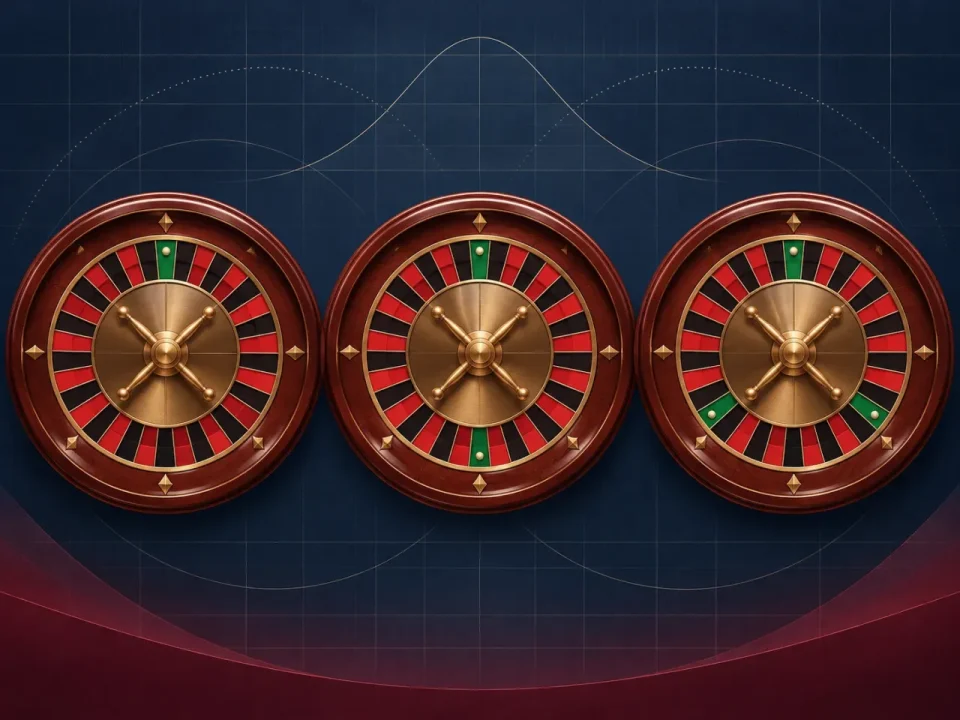
A single-zero wheel has 37 pockets. They are the numbers 1 through 36 plus one green 0. The Massachusetts Gaming Commission equipment rule describes those 37 equally spaced compartments and separately defines a double-zero wheel with 38 compartments, including green 0 and 00.
A triple-zero layout adds a third green result, commonly shown as 000, for 39 pockets in all. The Nevada Gaming Control Board rules of play explicitly identify 0, 00 and 000 as the three green outcomes on a triple-zero wheel. The document concerns an optional wager, but its description confirms the underlying layout without implying that the side wager is part of every roulette game.
The numbered red and black pockets still total 36 in each version. Consequently, the probability of any specified pocket is 1 divided by 37, 38 or 39 when the wheel is fair and every pocket is equally likely. The zeros are separate outcomes. A ball landing on 00 is not another way of recording 0, and neither result counts as odd, even, red, black, low or high under ordinary rules.
Standard payouts do not grow with the wheel
The key comparison is between the number of possible outcomes and the return for a winning wager. The Venetian roulette guide states that a single-number wager pays 35 to 1 and that red or black and odd or even pay 1 to 1. A 35-to-1 win returns 35 units of profit plus the original stake, so the total amount returned is 36 units.
On a single-zero wheel, one winning pocket out of 37 produces an average return of 36 divided by 37 for a straight-up wager. The return is about 97.30 percent and the difference, about 2.70 percent, is the house edge. The same calculation becomes 36 divided by 38 on a double-zero wheel, giving about 94.74 percent return and 5.26 percent house edge. With three zeros it is 36 divided by 39, or about 92.31 percent return and 7.69 percent house edge.
These are long-run mathematical averages, not forecasts for a session. A player can finish a short sequence above or below the average by a wide margin. The guide to RTP, house edge and volatility explains why an expected return describes repeated wagering rather than the next result.
Outside bets show the same effect
Red covers 18 pockets and black covers another 18. Odd, even, 1 to 18 and 19 to 36 also cover 18 numbered pockets each. On a single-zero wheel, an even-money wager therefore wins on 18 of 37 outcomes, about 48.65 percent. Its 18 winning units are balanced against 19 losing outcomes, leaving the same 2.70 percent edge.
With 0 and 00, the chance of winning an ordinary 18-number outside bet is 18 of 38, about 47.37 percent. Three zeros reduce it to 18 of 39, about 46.15 percent. The payout remains one unit of profit for one unit staked, so the house edges become 5.26 and 7.69 percent respectively.
The green pockets do not mean every roulette bet loses when zero appears. A straight-up wager placed on the winning zero can be paid, as can a valid split, trio or other layout wager that expressly includes it. The usual red, black, odd, even, high and low bets lose because their printed coverage excludes every green pocket. A table may offer special rules for some even-money bets, but those rules must be visible and should never be assumed from the wheel's color alone.
Inside bets keep the pattern when payouts are conventional
Conventional roulette payouts are scaled around the same 36-unit total return. A two-number split commonly pays 17 to 1, making 18 units returned when either of two covered pockets wins. A three-number street commonly pays 11 to 1, making 12 units returned. A four-number corner commonly pays 8 to 1, making 9 units returned, while a six-number line commonly pays 5 to 1 and returns 6 units.
Multiplying the winning pockets by the total return gives 36 in each example. Dividing that figure by the wheel's 37, 38 or 39 possible results produces the same ordinary edge as the straight-up bet. Changing from red to a single number changes how often and how much a win occurs, but it does not remove the zero-based disadvantage when the conventional paytable applies.
Special baskets, side bets and promotional layouts can break that pattern. Their coverage and payouts need a separate expected-value calculation. The Nevada document, for example, describes an optional two-consecutive-green wager with its own paytable. Its existence is not evidence about the return of standard roulette bets. The correct comparison always uses the actual pockets covered and the actual payout shown for that table.
One hundred units illustrates exposure, not destiny
If the same one-unit conventional wager were repeated 100 times, total turnover would be 100 units. Multiplying turnover by the mathematical edge gives an expected long-run cost near 2.70 units on single zero, 5.26 units on double zero and 7.69 units on triple zero. Those figures are averages over repeated play, not amounts that a player must lose in exactly 100 spins.
Stake progression does not alter these percentages. Doubling after a loss, switching colors or following recent results changes the timing and size of exposure. It cannot change the number of pockets or the payout. The round-cost guide helps turn a chip value and number of spins into total money at risk before play begins.
A wheel can also produce clusters and long gaps through ordinary randomness. Five reds in a row do not make black more likely on the next independent spin. Likewise, a recent zero does not make another zero due or impossible. Physical live wheels require operational controls, while software roulette uses certified outcome systems, but a displayed history is still a record rather than a prediction.
How to identify the game before betting
The table layout is more useful than a broad label such as European or American. Count the green betting spaces and verify whether they are 0, 00 and 000 or another clearly defined symbol. Then open the paytable and check the return for the exact wager. Confirm whether special zero rules, void spins, shared tables, side bets or bonus multipliers apply.
The UK Gambling Commission remote technical standard says the rules, game description and likelihood information must be accessible before gambling begins. That principle is useful anywhere. If the displayed layout and help screen disagree, do not infer the more favorable version. Pause and obtain the operator's authoritative rules.
Finally, compare equal stake and equal pace. A lower minimum on a triple-zero table can still produce more total exposure if it encourages more spins, while a higher minimum on a single-zero table may exceed a personal limit. Zero count determines the mathematical edge for conventional bets. Stake, speed and duration determine how much money is subjected to that edge. None of the three layouts offers a guaranteed win, and stopping limits remain more reliable than any betting system.