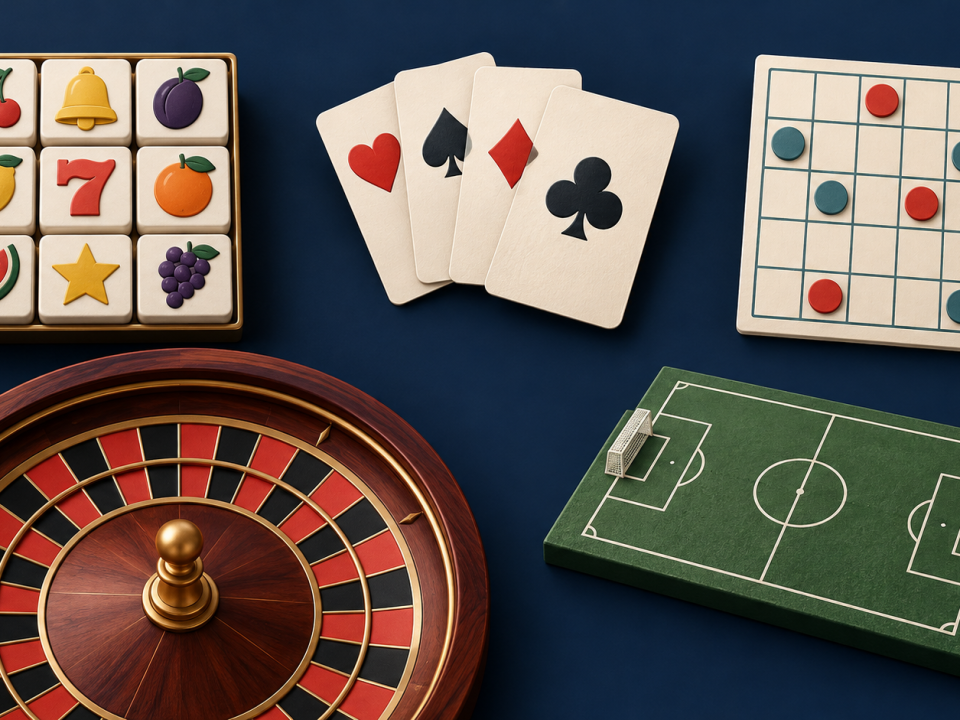
An online gambling lobby can put slots, live casino, poker and crash games next to one another, as though each label answered the same question. They do not. Poker names a family of games. Live describes a way of presenting and running a game. Crash describes a particular round structure. Understanding those differences makes the catalogue easier to read, without mistaking a new label for a new set of rules.
The useful starting point is not which game looks most exciting, but what actually determines the result. From there, it becomes easier to identify who is on the other side of a wager and which features change the game. Several descriptions can apply at once. They are layers, not competing boxes.
Start with the game family
A family groups games around recognisable rules. Slots evaluate arrangements of symbols. Poker games compare hands, although the rules for forming those hands differ. Roulette resolves bets through a numbered result. Bingo uses called numbers and a ticket’s winning requirements. These distinctions tell you more than a theme built around treasure, football or mythology.
Even a familiar family name leaves important details unresolved. PokerStars’ rules distinguish Texas Hold’em from Omaha, where the final hand must use exactly two private cards and three community cards. The shared poker label does not make the two games interchangeable. Similarly, a bingo catalogue can contain both 75-ball and 90-ball variants rather than one universal version of bingo.
Who is on the other side of the wager
A poker table and a casino game with poker in its name need not have the same financial structure. In conventional player-versus-player poker, participants compete against one another. Evolution’s Casino Hold’em instead compares the player’s hand with the dealer’s hand. It is a house-banked game even though its cards and hand rankings look familiar to a poker player.
Sports betting also has different structures. A fixed-odds bookmaker offers a price for a selection. A betting exchange matches opposing positions between customers, while pool betting distributes a pool after deductions among the winning stakes. The same race can therefore sit underneath different betting products. An exchange is not a new sport, and a shared pool is not the same arrangement as a fixed-price wager.
This is why a chat window or several people watching the same round cannot establish that a game is peer-to-peer. The relevant question is how bets are settled, not how many usernames appear on screen. Social presentation and the financial relationship belong on different parts of the map.
A mechanic is a rule that changes what happens
Within a slot, the method used to recognise a winning combination is a mechanic. Starburst uses paylines and expanding Wild symbols, with the expansion triggering a respin. Contact takes a different approach, awarding combinations made from connected matching symbols on a grid. Those are meaningful rule differences, not simply alternative artwork.
Other mechanics change how a round continues. In Starburst Galaxy, winning symbols disappear and replacements fall into the spaces. That cascading process differs from a respin, which spins positions again. A game can combine a winning-combination system with a continuation feature, so a single title may reasonably carry several mechanic labels.
Crash games organise the round around a rising multiplier and a point beyond which the player can no longer collect. High Flyer, for example, includes both manual cashout and a threshold set before the round. This describes how the round works. It does not mean that watching other players, or selecting a familiar threshold, makes its ending predictable.
Live and RNG describe another layer
A live dealer identifies a presentation and operating format, not a separate set of winning rules for every game in the lobby. RNG means random number generator. Roulette can retain its recognisable structure while being broadcast from a studio. Software-driven games use a different way of producing their outcomes. The presence of a video feed should not be read as a promise of more favourable odds.
Some products combine these elements. Evolution describes Lightning Roulette as live roulette with an additional randomly generated component. Calling it only live or only RNG would leave part of the design unexplained. A useful description keeps the underlying game, the live format and the added feature visible together.
The map extends beyond casino tables
A broad guide also needs room for number draws, instant-reveal games and regional card or dice traditions. These should not be pushed into the slot category just because they appear in the same app. Nor does a new animation, a mobile interface or a familiar licensed character establish a new game family. The rule that resolves the wager matters more than the screen’s styling.
Sports-like graphics deserve particular care. Sportradar’s Simulated Reality uses a simulation to produce sporting contests rather than reporting an actual match being played on a pitch. The visual resemblance to sport is not enough to identify the underlying event. This distinction matters before considering the odds or the name of a market.
A classification is not a prediction
Knowing the category helps you find the right rules, but it cannot tell you what a session will return. The Gambling Commission explains RTP as an average across many plays, not a repayment promise for each session. A feature name, a live studio or an elaborate bonus sequence does not remove the possibility of losing the money staked.
The practical use of this map is to read a game more precisely. Identify its basic rules, then look at the settlement model and the features added to it. Check the actual version’s help screen rather than assuming that a similar title works identically. This series will examine those layers in detail, beginning with the difference between playing against other participants, playing against the house and participating in a shared prize pool.